
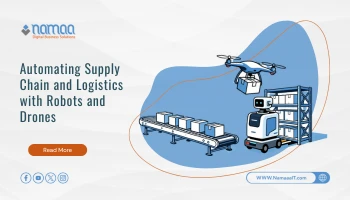


Supply chains face growing pressure to deliver faster, maintain inventory accuracy, and control costs. Automation has shifted from a competitive edge to an operational necessity. Autonomous mobile robots (AMRs) now operate 24/7 in warehouses, handling sorting and heavy loads with pinpoint accuracy, cutting human error and boosting safety. Meanwhile, drones revolutionize last‑mile delivery and enable aerial inventory scans in minutes. This dual transformation redefines supply chain and logistics standards using robotics and drones, empowering companies to manage massive order volumes with unprecedented efficiency.
Boosting Warehouse Efficiency with Autonomous Mobile Robots (AMR)
AMR efficiency in warehouses comes from their flexibility and independent operation, which reshapes internal processes. Unlike automated guided vehicles (AGVs) that follow fixed paths, AMRs use advanced sensors and AI algorithms to map environments, navigate obstacles intelligently, minimize downtime, and optimize material flow continuously. To maximize results, focus on:
- 24/7 operation: robots run non‑stop for consistent high productivity around the clock.
- Dynamic path optimization: real‑time rerouting avoids congestion or obstacles for the fastest possible transport.
- Human error reduction: automation handles repetitive transport tasks, minimizing order‑picking mistakes and stock loss. AMRs can reduce picking errors to under 1% in optimized setups.
Role of Drones in Reducing Shipping Costs and Last‑Mile Delivery
Drones provide a cost‑effective solution for distribution logistics, especially the "last mile," which can account for up to 50% of traditional logistics costs. These modern tools offer three core advantages for cost reduction and efficiency:
- Efficiency vs traditional vehicles: drone fleets operate at lower cost than truck‑based networks, particularly in dense urban or remote areas.
- Reduced delivery time: leading companies target 30 minutes or less, bypassing congested roads.
- Environmental and fuel savings: electric drones cut carbon emissions and fuel costs tied to trucks, aiding long‑term operations and compliance. Drone delivery costs could drop from $60 per parcel in 2020 to $4 by 2030 for similar or faster speeds.
Learn more: Smart and dynamic pricing
Best AS/RS Strategies for 2025
Success with automated storage and retrieval systems (AS/RS) in 2025 demands smart solutions beyond basic mechanization. For peak productivity, adopt these strategies:
Strategy | Direct Value to the Business |
|---|---|
Vertical space utilization | Densifies inventory and uses overlooked vertical areas, critical for high‑cost urban warehouses. AS/RS can improve vertical space efficiency by over 30%. |
AI reliance | Uses AI for demand forecasting and real‑time analysis, enabling predictive maintenance and zero downtime. |
Zero‑error achievement | Sensors and vision tech ensure precise item identification and handling for error‑free order fulfillment. |
IIoT integration | Connects all system components for full operational transparency and inventory tracking. |
Maximizing ROI in Logistics Robotics Systems
Achieve high, fast ROI in robotic automation by viewing it as process optimization, not just machine purchase. Avoid focusing only on upfront costs. Follow these success factors:
- Target high‑volume, repetitive tasks: start with labor‑intensive or high‑risk activities where error reduction and productivity gains show quickest financial impact.
- Scalability: choose expandable systems adaptable to growing orders or layout changes without full redesign.
- Deep software integration: ensure robots sync seamlessly with warehouse management systems (WMS) or ERP systems for smart decisions and real‑time data flow. Advanced automation ROI typically hits within 18–36 months.
Computer Vision Techniques Guiding Robots in Warehouses
Computer vision (CV) acts as the "eyes" of smart robots, enabling them to perceive, interpret, and respond to complex environments—a leap beyond simple mechanical systems. Key warehouse applications for precision and speed:
- Object detection and classification: identifies product types, sizes, and locations accurately for correct order picking.
- Simultaneous localization and mapping (SLAM): fuses camera data with LiDAR to build real‑time 3D warehouse maps, allowing independent navigation around sudden obstacles.
- Vision‑guided picking: deep learning algorithms like convolutional neural networks (CNNs) direct robotic arms to handle varied shapes and sizes, increasing packing flexibility. AI path optimization can reduce robot cycle times by at least 20%.
Read more: Cross-border sales
Selecting the Right Robot for Internal Transport (Intra‑Logistics)
Choosing the correct robot for intra‑logistics requires precise evaluation of task type, not just the latest tech. Base decisions on your facility’s storage, transport, material handling, or production‑line feeding needs. Use this framework:
Operation Type / Criterion | Recommended Robot Choice | Direct Selection Reason |
|---|---|---|
Flexible transport in dynamic, crowded environments | Autonomous mobile robots (AMR) | AI navigation around people and obstacles, ideal for shared spaces |
Heavy loads on fixed paths | Automated guided vehicles (AGV) | Efficient for heavy payloads on predefined routes, like production to assembly |
High‑level storage densification | Shuttle or crane‑based AS/RS | Maximizes vertical capacity and reduces internal aisles |
Individual item handling (sorting, picking) | Collaborative robots (Co‑bots) or robotic arms | Designed for human teamwork at workstations, precise sorting and grasping |
Cybersecurity and Data Protection in Smart Warehouses
Smart warehouses are prime cyberattack targets due to interconnected critical systems from industrial IoT (IIoT) to WMS. A single breach can halt operations and steal inventory or customer data. Implement a multi‑layer defense strategy:
- Network segmentation: isolate robot and machine networks from admin data networks to shrink attack surfaces and contain breaches.
- Strong encryption: secure all communications between robots and central controls to block interception or malicious commands.
- Firmware updates: keep robot software and controls current to patch known vulnerabilities and use latest security protocols.
FAQs
- What is the expected timeline for full robotic system rollout in a mid‑sized warehouse?
Implementation typically takes 6–12 months, covering system design, infrastructure adjustments, WMS/ERP integration, and initial testing. - Can collaborative robots (Co‑bots) work in human environments without physical barriers?
Yes, Co‑bots use sensitive sensors meeting safety standards to detect humans and slow or stop instantly near obstacles, eliminating traditional fencing or cages. - What is better for funding automation: buying or leasing?
Leasing offers greater flexibility and lower upfront costs, ideal for preserving working capital and faster tech upgrades. Buying provides long‑term ownership and reduced recurring fees.
Conclusion
✅ AMRs reduce order‑picking errors to under 1%, ensuring high inventory accuracy.
✅ Drones can cut last‑mile delivery costs by up to 50% compared to traditional road shipping.
✅ AS/RS systems boost vertical space efficiency by over 30%.
✅ AI systems optimize robot paths, reducing transport cycle time by at least 20%.
✅ Advanced automation ROI typically occurs within 18–36 months.